How AI Search Is Changing Online Reputation Management in 2026
INSIGHTS• AI SEARCH & REPUTATION

AI search does not simply reorder links. It can assemble a brand narrative from several sources before a user visits any website.
By the Trust Plan Editorial Team · Updated September 4, 2026
A potential customer asks an AI search tool whether your company is trustworthy. A candidate compares your employer reputation with a competitor’s. An investor asks for a summary of a past controversy. Instead of receiving ten links, each person may receive a direct answer assembled from company pages, reviews, media coverage, business profiles and other web sources.
That changes the first impression. For years, online reputation management focused heavily on what appeared on page one for a fixed list of branded queries. That work still matters, but it is no longer the whole picture. In 2026, brands also need to understand what AI systems say, which sources support the answer, where the facts conflict and whether the user has any reason to continue to the original source.
The practical goal is to improve the evidence available to both people and machines. No company can “control the AI” or guarantee a citation, a ranking or a particular generated answer. Brands can still make accurate, current and well-supported information easier to discover, verify and attribute, while identifying reputation risks before they become part of an AI-generated narrative.
Key takeaways
·AI search turns reputation from a list of results into a synthesized answer supported by multiple sources.
·Traditional SEO remains the technical foundation. Google says there are no special requirements or special schema markup for inclusion in AI Overviews or AI Mode.
·Monitoring must cover prompts, answers, cited URLs, factual accuracy and source diversity — not rankings alone.
·Owned content needs clear evidence, consistent entity information and visible authorship; independent sources and genuine reviews still help people verify the picture.
·Measurement is improving. Google and Bing now provide dedicated visibility data for generative search experiences, but no dashboard captures the entire reputation journey.
What changed: the answer now comes before the click
Classic search presents choices. AI search can interpret a question, run several related searches, compare sources and generate a response. Google explains that AI Overviews and AI Mode may use “query fan-out”: the system issues multiple searches across subtopics and data sources before constructing an answer.[1]
For a brand, one prompt can therefore open a much wider reputation surface than a traditional branded keyword. A question such as “Is Company X a reliable partner?” may lead the system to investigate reviews, complaints, leadership, policies, recent news, service quality and alternatives. The exact source set may change across tools and prompts. Even Google notes that AI Overviews and AI Mode can use different models and techniques, so their responses and links may vary.[1]
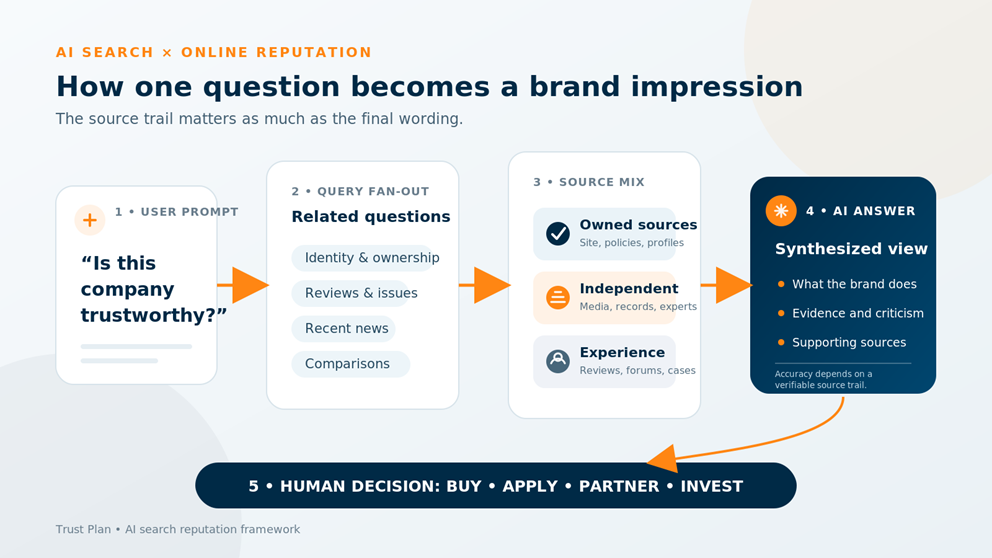
One question can trigger several lines of research. The resulting answer may combine owned, independent and user-generated sources.
This creates three important changes for reputation teams.
1. Reputation is assembled at the passage level
A page does not need to rank first for every branded query to influence an AI answer. A useful paragraph, table, policy statement or clearly attributed fact may become a supporting source. Conversely, a stale sentence buried on an old page can create confusion if it conflicts with newer information.
This is why page-level and passage-level clarity matter. Dates, locations, product names, executive roles, prices, policies and status changes should be explicit. A visitor — human or machine — should not have to infer which version is current.
2. A broader set of questions can shape perception
People can ask conversational follow-ups instead of starting a new search. They may move from “What does this company do?” to “What are the main complaints?”, “Has it resolved them?” and “How does it compare with an alternative?” in the same session.
A conventional brand-monitoring list may miss this discovery path. Effective reputation monitoring now needs prompt families that reflect real decisions, objections and risks.
3. Zero-click visibility is still reputation visibility
A user may form an opinion without visiting your site. That makes citations, factual accuracy and framing meaningful even when referral traffic is modest. Clicks still matter, but they are no longer the only sign that your information influenced a decision.
SEO, SERM and GEO are related — not interchangeable
The growth of generative search has produced a new label: generative engine optimization, or GEO. It is useful when it describes work aimed at understanding and improving visibility in AI-generated answers. It becomes misleading when presented as a secret replacement for SEO.
Google’s own guidance is direct: the same foundational SEO practices apply to AI Overviews and AI Mode, with no additional technical requirements and no special schema markup needed.[1] A page must still be accessible, indexable and eligible to appear in Google Search with a snippet. Helpful content, internal links, a good page experience and structured data that matches the visible page remain relevant.
The disciplines play different roles:
·SEO helps search engines discover, understand and surface content.
·SERM focuses on the composition and perception of branded search results.
·GEO examines whether content and entities appear accurately in generated answers and citations.
·Online reputation management connects all three with reviews, media relations, crisis response, stakeholder communication and operational fixes.
A strong 2026 strategy does not choose one acronym. It builds a verifiable information environment across search and AI discovery.
How AI search changes the reputation risk model
Conflicting facts can become a narrative problem
Suppose a company’s website lists a new CEO, an industry directory shows the former executive and a two-year-old article describes a restructuring as if it were ongoing. A person reviewing the sources may spot the timeline. A generated summary may compress those facts into an ambiguous statement.
The remedy is not repetition. It is source hygiene: update the canonical page, add a visible date, correct authoritative profiles, publish the change clearly and request factual corrections where appropriate.
Old criticism can regain visibility in a new context
A negative article that has moved down in classic search can still be relevant to a detailed question about a specific incident. AI search can retrieve information by topic rather than merely reproducing the current top ten for the brand name.
That makes a factual response page, documented resolution and updated third-party coverage more valuable than a stack of generic positive articles. If harmful material is false, defamatory or violates a platform’s rules, pursue appropriate removal or correction channels. If it is accurate, explain what changed and support the explanation with evidence. Trust Plan’s guide to managing negative online content outlines the broader defensive process.
Inconsistency across formats becomes harder to ignore
A website, business profile, press release, review-platform response, video description and executive biography may all describe the same entity. If names, dates or claims differ, the brand creates avoidable ambiguity.
Maintain one approved fact base for high-risk information, but adapt the presentation to each audience. Consistency should apply to facts, not turn every channel into duplicate copy.
Reviews remain decision evidence, not content inventory
AI search does not make fake or incentivized reviews acceptable. Genuine customer feedback can reveal recurring strengths and problems; fabricated feedback creates legal, platform and reputation risk. The useful response is operational: request honest reviews from real customers, answer specific concerns, document resolutions and feed recurring issues back into the business. See Trust Plan’s approach to online review management.
A seven-step AI search reputation framework
Step 1: Map the questions that matter
Start with decisions, not tools. Build prompt families for:
1. Identity: What does the company do? Who owns or leads it?
2. Trust: Is it legitimate, safe or reliable?
3. Evaluation: What are its strengths, weaknesses and common complaints?
4. Comparison: How does it differ from named competitors?
5. Risk: Has it faced lawsuits, recalls, breaches or controversies?
6. Experience: What do customers, employees and partners report?
7. Action: Should someone buy, apply, invest, book or contact the company?
Add local-language versions, common misspellings, product names and executive names where relevant. Record the exact prompt, tool, location or market, date, account state and answer. Generated results are not static, so a screenshot without this context is weak evidence.
Step 2: Build a source map for every important claim
For each prompt family, identify the sources a careful researcher would expect to find:
·canonical company pages;
·regulatory filings and public records;
·business and professional profiles;
·policies, pricing and support documentation;
·media coverage and interviews;
·review platforms and forums;
·customer stories and case studies;
·leadership biographies and social profiles.
Classify each source as accurate, outdated, incomplete, disputed or irrelevant. Also mark whether the company owns it, can request an edit or can only respond publicly. This turns an abstract “AI reputation problem” into a manageable evidence backlog.
Step 3: Establish a canonical source of truth
Create or improve a clearly structured page that answers basic entity questions: official name, services, locations, leadership, contact details and other facts appropriate to the business. For high-risk topics, publish dated statements, policy pages or incident updates rather than scattering explanations across unrelated posts.
The canonical source should be easy to find through navigation and internal links. Important facts should appear as HTML text, not only inside an image, video or downloadable PDF. Relevant structured data can reinforce what is visible on the page, but it should never introduce claims that users cannot see.
Step 4: Publish evidence, not reputation filler
Generic praise is easy to produce and hard to trust. Better content includes named expertise, original analysis, transparent methodology, dated examples, primary documents and limitations.
A useful article should answer a real stakeholder question. A case study should explain the starting point, intervention and measurable result without exposing confidential information. A correction should identify precisely what was wrong. A leadership page should make authorship and accountability visible.
This evidence-first approach is also the basis of positive content development: create material that deserves to be found rather than content whose only purpose is to occupy space.
Step 5: Improve independent corroboration
Owned pages are necessary, but users often want external confirmation. Earn relevant coverage through genuine expertise, useful data, interviews, partnerships and newsworthy actions. Keep important industry profiles accurate. Encourage real clients to describe specific experiences in their own words.
Do not confuse distribution with duplication. Publishing the same lightly edited press release across low-quality sites may expand the URL count without adding credibility. One strong, relevant, independently edited source can be more useful than dozens of interchangeable pages.
Step 6: Check access and freshness
Technical barriers can cancel out good editorial work. Google requires a page to be indexed and eligible for a search snippet before it can appear as a supporting link in AI Overviews or AI Mode.[1] Bing continues to recommend XML sitemaps and IndexNow to support discovery and freshness across search and AI experiences.[4]
Crawler policy also needs a deliberate decision. OpenAI documents separate controls for OAI-SearchBot, which supports inclusion in ChatGPT search, and GPTBot, which relates to potential model training.[5] A publisher can allow one and disallow the other. Treat these settings as governance choices, not a copied “AI SEO” recipe. Confirm that your robots.txt, CDN, firewall and consent tools implement the policy you actually intend.
Step 7: Monitor, correct and learn
Run the agreed prompt set on a schedule, but do not reduce the output to a single visibility score. Review:
·whether the brand appears;
·whether the description is materially accurate;
·which claims are positive, neutral, critical or unsupported;
·which URLs are cited;
·whether the source set is diverse;
·whether an old issue is presented with its resolution;
·what changed since the previous observation.
When an answer is wrong, trace the claim to its likely sources. Correct owned pages first, then address third-party errors through documented editorial or platform procedures. Retest after sources are updated, while recognizing that crawling and answer generation take time.
How to measure AI reputation without inventing certainty
In 2026, platform data is more useful than it was a year ago. Google announced dedicated Search Generative AI performance reports in Search Console and, as of August 31, 2026, says the insights have rolled out to all websites worldwide.[2] The reports show impressions, which pages appeared, countries, devices and trends over time for generative AI features in Search and Discover. The data remains part of overall Search performance as well.
Bing’s AI Performance report, introduced in public preview in February 2026, reports total citations, average cited pages, sampled grounding queries, page-level citation activity and trends across supported Microsoft AI experiences.[3] Microsoft explicitly warns that citation counts do not indicate ranking, authority or placement within an individual answer.
These platform reports are valuable, but an ORM dashboard should connect four layers:
Use absolute counts next to percentages. Preserve the exact prompt set and methodology. Separate observed answers from platform-reported impressions or citations. If a monitoring tool cannot show its collection date, market, engine and source links, its score is not auditable.
What brands should stop doing
·Stop treating one chatbot answer as a permanent result. Generated answers vary and change.
·Stop publishing vague “positive” articles. Unsupported praise does not resolve a disputed fact.
·Stop measuring only website clicks. A cited fact can influence a decision before a visit.
·Stop assuming more schema is the solution. Google says no special AI schema is required.[1]
·Stop mixing crawler controls. Search inclusion, model training and user-requested page visits can involve different agents and policies.[5]
·Stop promising guaranteed AI citations or sentiment. Eligibility and good practice do not guarantee selection.
A practical 90-day plan
Days 1–30: establish the baseline
·Define priority markets, audiences and prompt families.
·Capture AI answers and classic search results under documented conditions.
·Inventory cited and uncited sources.
·Audit core facts, profiles, reviews, robots.txt, indexing and analytics.
·Escalate urgent inaccuracies or harmful content through the appropriate process.
Days 31–60: close evidence gaps
·Update the canonical company and leadership information.
·Publish or improve pages for recurring questions and high-risk topics.
·Add visible dates, authorship, sources and clear update histories.
·Correct priority third-party profiles.
·Strengthen internal links and submit updated URLs through the relevant webmaster tools.
Days 61–90: build resilience
·Earn independent coverage around real expertise or evidence.
·Improve review-response workflows and route recurring complaints internally.
·Compare answer accuracy, citation sources and visibility with the baseline.
·Connect platform data to qualified traffic and business outcomes.
·Set a monthly monitoring and correction cadence.
The new objective: become easy to verify
AI search has not eliminated the fundamentals of reputation management. It has made weak fundamentals more visible. A brand with inconsistent facts, thin content, neglected profiles and unresolved criticism gives an answer engine little reliable material to work with. A brand with clear sources, independent corroboration, genuine reviews and documented corrections is easier for both people and systems to assess.
A credible strategy does not manufacture a flawless narrative. It makes the truthful one easier to discover, understand and verify.
If you need a baseline, Trust Plan can review your branded search results, AI-generated answers, cited sources and priority reputation risks, then turn the findings into a practical action plan. Request a confidential reputation management strategy.
Frequently asked questions
Can a company guarantee that it will be cited by ChatGPT, Google AI Overviews or Copilot?
No. Crawl access, indexing, technical quality and strong content can improve eligibility, but they do not guarantee a citation or a specific answer. Any agency promising guaranteed inclusion is overstating its control.
Does AI search optimization replace SEO?
No. AI visibility still depends heavily on discoverable, accessible and understandable web content. Google explicitly says its established SEO best practices remain relevant to AI Overviews and AI Mode.[1]
Should we create an llms.txt file?
Treat it as an optional experiment, not a substitute for crawlability, indexing, sitemaps, internal links or clear content. Google says no new machine-readable file or special markup is required for its AI search features.[1] Follow each platform’s current official crawler documentation instead of assuming one file controls every system.
What should an AI reputation audit include?
At minimum: prompt families, exact answers, dates and markets, cited URLs, factual-accuracy review, sentiment and issue framing, source ownership, classic search results, technical access, analytics and a prioritized correction plan.
Sources
1. Google Search Central, AI features and your website.
2. Google Search Central Blog, Introducing Search Generative AI performance reports in Search Console, June 3, 2026; rollout note updated August 31, 2026.
3. Bing Webmaster Blog, Introducing AI Performance in Bing Webmaster Tools Public Preview, February 10, 2026.
4. Bing Webmaster Blog, Keeping Content Discoverable with Sitemaps in AI Powered Search, July 31, 2025.
SEO and publication details
06.10.2026